
Updated September 2026
Choose a hobby you can try this week
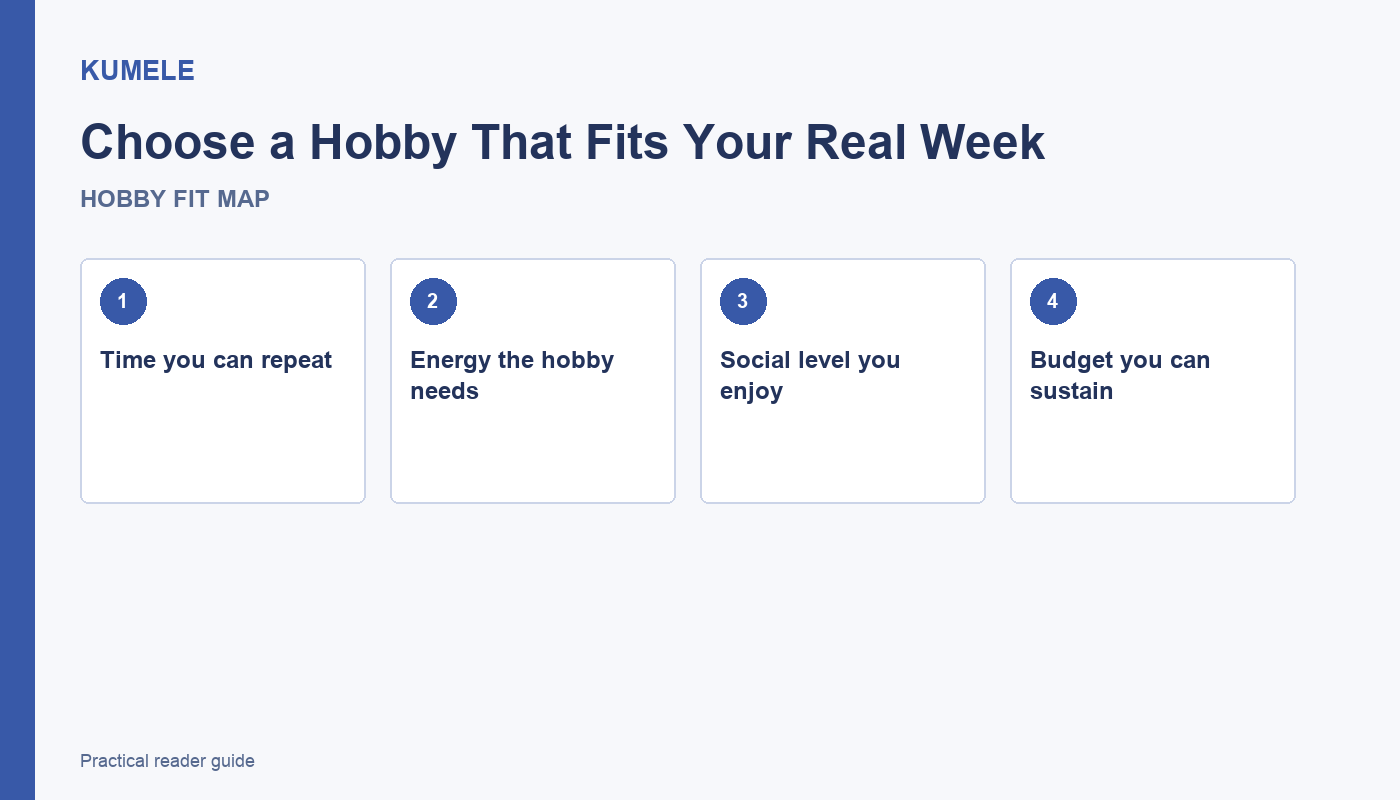
The best hobby is not the most impressive one. It is the activity that fits your available time, energy, budget, and preferred level of company. Start with one low-cost session, then decide after four tries rather than after one awkward beginning.
The right hobby isn’t the one that looks best on a weekend Instagram post. It’s the one that survives a bad Wednesday — fits your time, energy, money, and how much company you actually want. Start with those four filters before you fall in love with an idea, and you’ll quit fewer things.
Jump to: Fit · Ideas · Test · Social · Mistakes · FAQ
Fit: time, energy, budget, and how social you want it
Time is the first filter most people ignore. A hobby that needs three uninterrupted hours will lose to laundry every time. Be honest about the real blocks you have — twenty minutes after dinner, one weekend morning, a lunch break — and pick something that lives in that slot.
Energy is the quieter one. After a hard workday, woodworking sounds romantic until you’re standing in a cold garage at 9 p.m. Low-energy hobbies (reading, sketching, cooking simple things) belong on tired nights. High-energy ones (climbing, dance, trail running) belong on fresh mornings. Matching the hobby to your actual battery level matters more than passion.
Budget has two costs, not one. There’s the entry cost and the ongoing cost. A $40 film camera turns into film and developing fees forever. A running club costs shoes. Guitar costs the guitar plus the years of strings and repairs. Some people love gear — for them, the spending is the fun. Others resent it. Know which you are.
Social fit is where most “I should pick up a hobby” plans die. If you’re lonely, a solo craft will quietly make it worse. If you’re peopled out by Thursday, a weekly meet-up becomes another obligation. Decide upfront: solo, small group, or public-with-strangers. There’s no right answer, but lying to yourself here guarantees you quit in a month.
If you want more possibilities before narrowing the list, the Kumele hobbies guide groups ideas by the kind of experience they offer.
Ten hobby ideas for adults, compared honestly
| Hobby | Time to start enjoying | Typical monthly cost | Social? | Quiet tradeoff |
|---|---|---|---|---|
| Bread baking | 2–3 attempts | $15–30 | Shareable, mostly solo | Your kitchen gets messy at odd hours |
| Running | 2–3 weeks | $0–40 | Solo or group | Weather and motivation ebb and flow |
| Watercolor | First session | $10–25 | Mostly solo | Progress is slow and non-linear |
| Board games | Same night | $0–30 | Very social | You need reliable people nearby |
| Trail hiking | First hike | $0–20 | Solo or with friends | Travel time eats the day |
| Letterpress / linocut | 3–4 sessions | $30–60 | Mostly solo | Ink and tools take up real space |
| Home cooking beyond recipes | Ongoing | $40–100 (offsets meals) | Shareable | Planning fatigue is real |
| Language learning | 4–6 weeks | $0–20 | Can be social | Plateau around month three breaks people |
| Photography (phone) | Same day | $0 | Solo or social | Easy to mistake gear lust for progress |
| Gardening (containers) | 2–3 weeks | $10–40 | Mostly solo | Plants die on vacation weeks |
Food hobbies deserve their own conversation because they sit on a strange line between hobby and chore. If you already cook every night, the question isn’t whether to start — it’s whether to deepen. Our food hobby guide covers that split.
The four-week low-risk hobby test
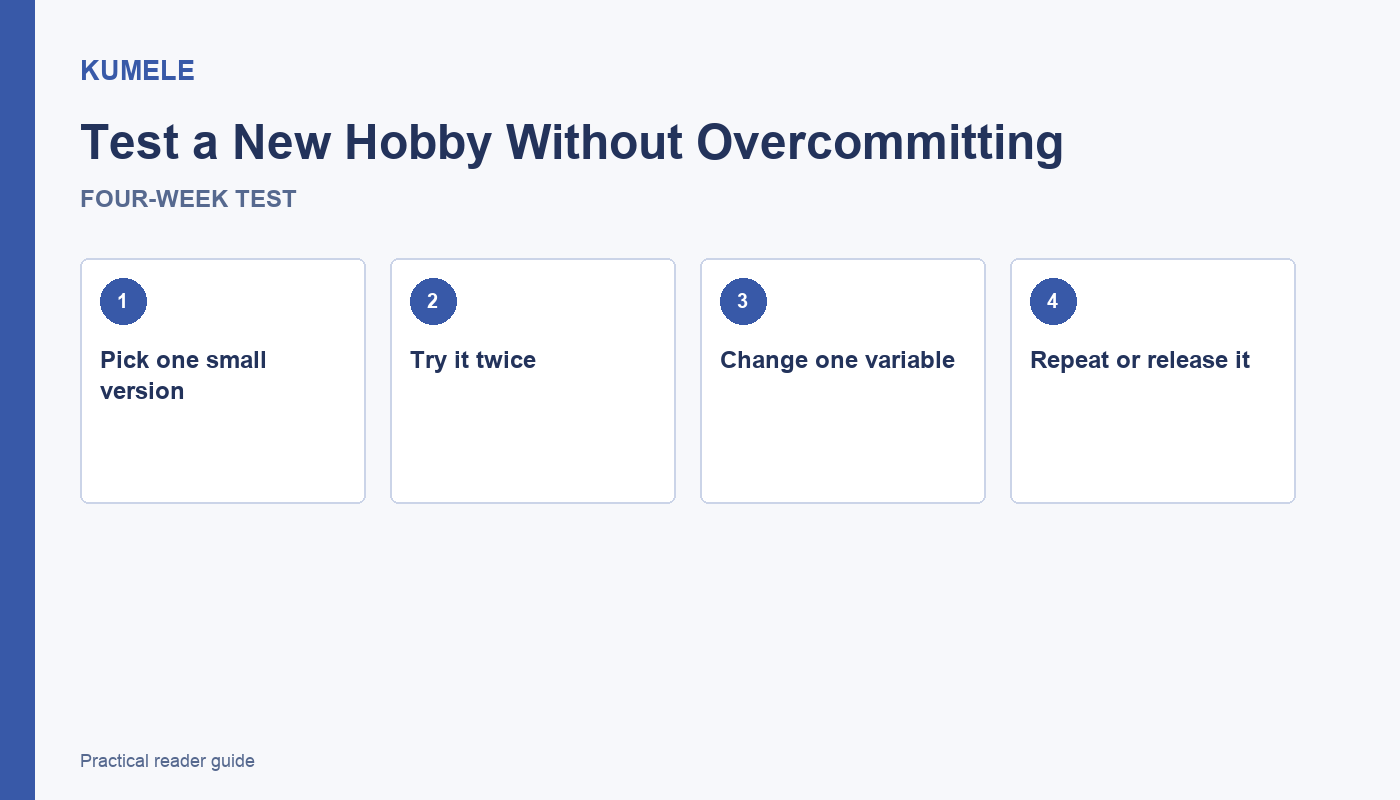
Pick one hobby and commit four weekends to it before you judge the result. Four is enough to clear the awkward first attempt, get a feel for the gear or vocabulary, and notice whether you actually look forward to session three. One session tells you nothing. Two tells you slightly more. Three is where most people quit, right before it gets interesting.
The low-risk part matters. Borrow, rent, or buy used for the first round. A library ukulele, a friend’s sewing machine, a community center pottery wheel, a trail running group that lends trekking poles. If week four ends and you felt nothing, you walk away without a closet full of equipment and a vague sense of failure. If you felt something, you now know exactly what to invest in.
Track three things across the four weeks: did you finish a session tired in a good way, did you think about it during the week unprompted, and did you tell anyone about it. If the answer to two of those is yes, continue. If all three are yes, it is probably worth paying for real gear. If none are yes, try something else. There is no character flaw in a hobby not clicking. It is information.
Keep a small notebook or note on your phone with one sentence per session. By week four you will have a tiny record that tells you more than your mood on any given day. People often give too much weight to the most recent session. Four short notes even that out.
Solo, class, club, or informal group
Format shapes the experience more than the hobby itself. Sketching alone at a kitchen table is a different activity than sketching at a Tuesday drop-in at the library. Same pencil, different thing.
Solo is the easiest entry and the hardest to sustain. Zero scheduling friction, zero social pressure, and zero accountability. Good for hobbies where you already know you like the activity and just need to protect time for it. Bad for anything you are hoping will pull you out of a rut. If solo keeps drifting off your calendar, that is not a willpower problem, that is a format problem.
Classes have a teacher, a curriculum, and a fixed end date. You pay, you show up, you get better in a structured way. The downside is cost and the fact that everyone else is also a paying stranger with no obligation to keep showing up after week six. Classes are the best format for total beginners because the structure removes decisions.
Clubs are ongoing, member-run, and usually cheap or free. They have personalities. Some are welcoming to newcomers, some are quietly closed circles that happen to meet in public. Visit twice before deciding. A club that ignores you on the first visit may simply be mid-project. A club that ignores you on the second is probably not for you.
Informal groups sit between clubs and solo. A coworker who walks every Saturday, a neighbor who bakes, a group chat of three people who knit on Thursday evenings. Low ceremony, high flexibility, and they dissolve easily if even one person drops. The Kumele guide to finding hobby groups near you explains practical places to look while the platform remains in prelaunch.
Hobbies to meet people without promising friendship
Treat social hobbies as a way to be around people doing something, rather than as a friendship guarantee. Friendship sometimes follows. Often it does not. Both outcomes are fine. The Cleveland Clinic’s guide to making friends as an adult offers practical suggestions for meeting people and giving new connections time to develop.
Pick a hobby with a shared object in the room. Board games, choir, hiking, pottery, repair cafés, community theater, birding walks. The shared object gives you something to talk about that is not yourself, which is the entire trick. Purely conversational settings are harder. A book club is easier than a meetup for talking, because the book is there doing half the work.
For shy adults, choose hobbies with a task to focus on. Trail maintenance, sorting donations at a food bank, folding origami at a library table. Your eyes are on the task, not on people, and conversation happens sideways. Avoid anything labeled networking or mixer. That vocabulary exists for a different personality.
For busy adults, pick hobbies with fixed weekly times and no catch-up obligation. A Sunday morning bird walk you can miss without guilt is better than a project-based group that depends on you. You will miss sessions. Choose a format that survives that.
For adults returning after a long break, start one level below where you left off. If you played violin at sixteen, do not buy a violin on day one. Find a community orchestra that welcomes rusty adults, or a chamber music meetup that explicitly says so. Your old skill is there. Your current stamina and free time are not. The gap between memory and present ability is where people quit. Lower the starting line and the gap disappears.
Finding local options safely
When you decide to take your hobby offline, the goal is to learn and relax, not to compromise your safety. Finding local groups requires a bit of skepticism. You are meeting strangers, even if you share an interest in pottery or birdwatching.
Always meet in public for the first few sessions. Coffee shops, public libraries, and community centers offer neutral ground and foot traffic. If a group insists on meeting in someone’s private home before you know them, decline. Good organizers understand this hesitation and will suggest a public alternative.
Limit the personal information you share early on. You do not need to hand over your home address or workplace to join a knitting circle. Use a first name and a dedicated email address for hobby communications until trust is established. Keep early group chats focused on the activity, meeting point, and schedule.
Remember that a platform cannot guarantee a specific group or immediate connection. If you are looking for hobby friends, focus on shared schedules and clear interests, and take time to decide whether a group feels right for you.
Useful hobby apps versus doing the hobby
There is a real tradeoff between managing your hobby and actually doing it. Apps can be useful for tracking progress, finding patterns, or managing your yarn stash, but they can also become a form of productive procrastination. If you spend forty minutes logging your knitting supplies and ten minutes actually knitting, the app is failing you.
According to a Cleveland Clinic article, hands-on hobbies like knitting, crocheting, and cross-stitch can support relaxation by anchoring your attention in the present moment. But this benefit only happens when your hands are moving. An app cannot replicate the tactile feedback of working with your hands. The screen time often cancels out the grounding effect.
Digital tools can track your running pace, but they cannot run the miles for you. A community platform can help you find accountability partners, but it won’t build your endurance. When evaluating the best hobby apps for adults, look for tools that get out of your way. A good app should help you schedule a meetup, locate a trail, or track a supply list, then close. Be honest with yourself about why you are opening an app. If it is to avoid the frustration of learning a difficult stitch, you are better off putting the phone down and struggling with the yarn for twenty minutes.
Common mistakes and fixes
Two traps ruin new hobbies faster than a lack of time: identity-shopping and buying equipment too early. Both stem from a desire to feel like a “real” participant before you have earned it through practice.
Identity-shopping happens when you adopt a hobby to project an image rather than to do the work. You buy the flannel, the artisanal axe, and the leather journal before chopping a single log. The problem is that when the hobby gets hard or boring—which it always does—the identity shatters. You quit, because the persona is no longer fun to maintain. The fix is to commit to ten hours of actual practice before buying any branded merchandise. Let the habit form the identity, not the other way around.
Buying equipment too early is the second cousin to identity-shopping. It is tempting to drop five hundred dollars on a mirrorless camera to learn photography. But expensive gear masks your lack of skill and creates pressure. You feel guilty if you don’t use the equipment, which turns the hobby into an obligation. Worse, high-end gear often complicates the learning process because you have to learn how to use the tool instead of focusing on the craft.
The fix is strict rationing. Use your smartphone to learn framing and lighting. Borrow a basic sewing machine from a friend. Buy cheap acrylic yarn instead of luxury merino. Only upgrade when the cheap gear actively limits your progress. If you find yourself researching the “best” gear for more than an hour, step away from the browser. If you can’t take a decent photo with a phone, a thousand-dollar lens won’t help. By delaying the purchase, you ensure your motivation is the craft itself, not the gear acquisition.
Common questions
What if I don’t have any interests?
Most people don’t have zero interests. They have interests they’ve dismissed as silly or unproductive. Scroll your phone history, recall what you liked at twelve, or walk through a library and note which section pulls you. That pull is data. Act on it before you overthink it.
Can I start a hobby with almost no money?
Yes, but accept the tradeoff. Free hobbies like walking, sketching, or journaling cost time instead of money. Borrowed gear and library resources work for testing interest. Budget constraints force creativity early, which is a feature, not a bug. You’ll know whether to invest before you’ve spent much.
I get anxious in groups. Any advice?
Solo-first hobbies let you build skill privately. Many hobbyists start alone and only later share with others. When you do show up to a group, you can arrive late, leave early, and skip the small talk by focusing on the activity itself. Shared attention on a task is easier than open-ended socializing.
Is quitting a hobby a failure?
No. Quitting is information. You tried it, you learned it wasn’t for you, and you moved on. The cost was a few weeks and some supplies. The alternative is forcing yourself through something you dislike, which kills the whole point of having hobbies. Give yourself permission to walk away.
How much time does a hobby really need?
Less than you think. Two focused hours per week is enough to make progress in most hobbies. Twenty minutes daily beats a marathon weekend session because consistency compounds. The barrier isn’t time, it’s starting and stopping repeatedly. Protect a small slot and guard it.
How do I choose just one when I want to try everything?
Pick one that has the lowest barrier right now. Not the most exciting, not the one with the best community, the one you can start this week with what you already have. Momentum matters more than the perfect choice. You can rotate later, but starting beats optimizing.
What to do next
Choose one hobby from your short list. Commit to two sessions this week, no more. Notice what happens during and after, including whether you are curious to return. Skill comes later.
Kumele is a prelaunch community platform built around hobbies and local interests. Joining the city waitlist records interest in your area and helps the team decide where to focus early outreach. It does not promise an available local group, a connection, or a launch date.